By Curtis E. LeMay Center for Doctrine Development and Education
MAXWELL AIR FORCE BASE, Ala. — The Air Force doesn’t get to choose when the character of war changes—but it can choose whether it meets that change prepared or late. That premise powered the Air Force Doctrine 2035 (AFD35) Wargame, a three-day operational event conducted in April designed to bring warfighters, technologists, and academic thought leaders into the same room to pressure-test emerging capabilities against realistic combat problems, then translate the lessons into doctrine that can guide the fight in 2035 and beyond.
AFD35 is a deliberate push against doctrinal surprise and stagnation, an effort that scoured the nation in discovery of disruptive technologies at the heart of the U.S. Air Force's future technology, and deep inside the National Industrial and academic complexes throughout 2025 was brought forward to inform the wargame. This game was designed purposefully to test what those technologies mean in conflict rather than in theory. The wargame’s design does not aim to produce a single “right answer,” but to expose what the force believes it knows now versus what will actually survive contact when a pacing threat is actively hunting assumptions in an Air Force doctrine-shaped environment of 2035.
"AFD35 clearly demonstrated that our technological edge in AI, quantum, and autonomous systems must be matched by a deliberate investment in human cognitive readiness. Testing our doctrine against these future operating conditions is vital because it forces us to recognize that we are not just acquiring new tools; we are building a collaborative 'third space' where human reasoning and machine pattern recognition must seamlessly team together to win." -- Wendy Walsh, Chief Learning Officer, Air Education and Training Command (AETC)
The construct is intentionally operational and intentionally uncomfortable. Instead of letting teams “wish” a solution into existence, the wargame forces trade-offs, and hard force design and employment decisions. Participants begin with bounded scarcity: investment choices across technology areas to mirror real-world constraints, fund one advantage, and accept risk somewhere else. Those investments then unlock capabilities, which become force design options, which are finally employed through scenario turns using discrete capability strategies. The principal value of the exercise lies not in producing a perfect plan, but in examining how teams reason under pressure, what their deliberations reveal as enduring truths, and where that reasoning begins to inform doctrine.
AFD35’s value is amplified by its diverse technological, command and operational mix of participants. Warfighters bring operational judgment where command relationships function under fire, revealing what breaks first, and what must be simple to get to reality. Industry brings technical reality, what is truly deployable and supportable, what scales, what fails quietly, and what can be made resilient. Academia brings rigorous skepticism and clarity, testing future-shaped assumptions, tracing consequences, and turning complexity into teachable frameworks. The wargame is intentionally unclassified to maximize that breadth of perspective.
The wargame is nested within a broader AFD35 effort that rigorously investigated five critical technology focus areas over six months, in a coast-to-coast discovery sprint to catalyze the framing and design of the game. These five areas are chosen to get at the deeply evolving tech landscape we will face in 2035. The core technology areas are: artificial intelligence and automation; advanced materials and production; biotechnology and neuroscience; robotics and miniaturization; and quantum sciences.
Participants were challenged to see the game’s core technology areas as interlocking puzzle pieces that, when fused with doctrinal principles, reveal how emerging capabilities could disrupt the way the Air Force plans, commands, sustains, and fights in the degraded, contested operating environments of 2035. The wargame began from a hard premise: airpower superiority in 2035 will not be secured by a single platform, one domain, or any exquisite capability in isolation. It will depend on whether the Air Force can convert technical possibility into operational advantage faster, more coherently, and at greater scale than a pacing threat determined to degrade networks, confuse decision-making, disrupt force posture, and impose counters that future doctrine must be able to absorb. To force that shift from what is merely possible to what is operationally useful, teams worked through scenario play tied to the Air Force’s central warfighting problems: information operations, air superiority, long-range strike, homeland defense, and contested logistics through Agile Combat Employment.
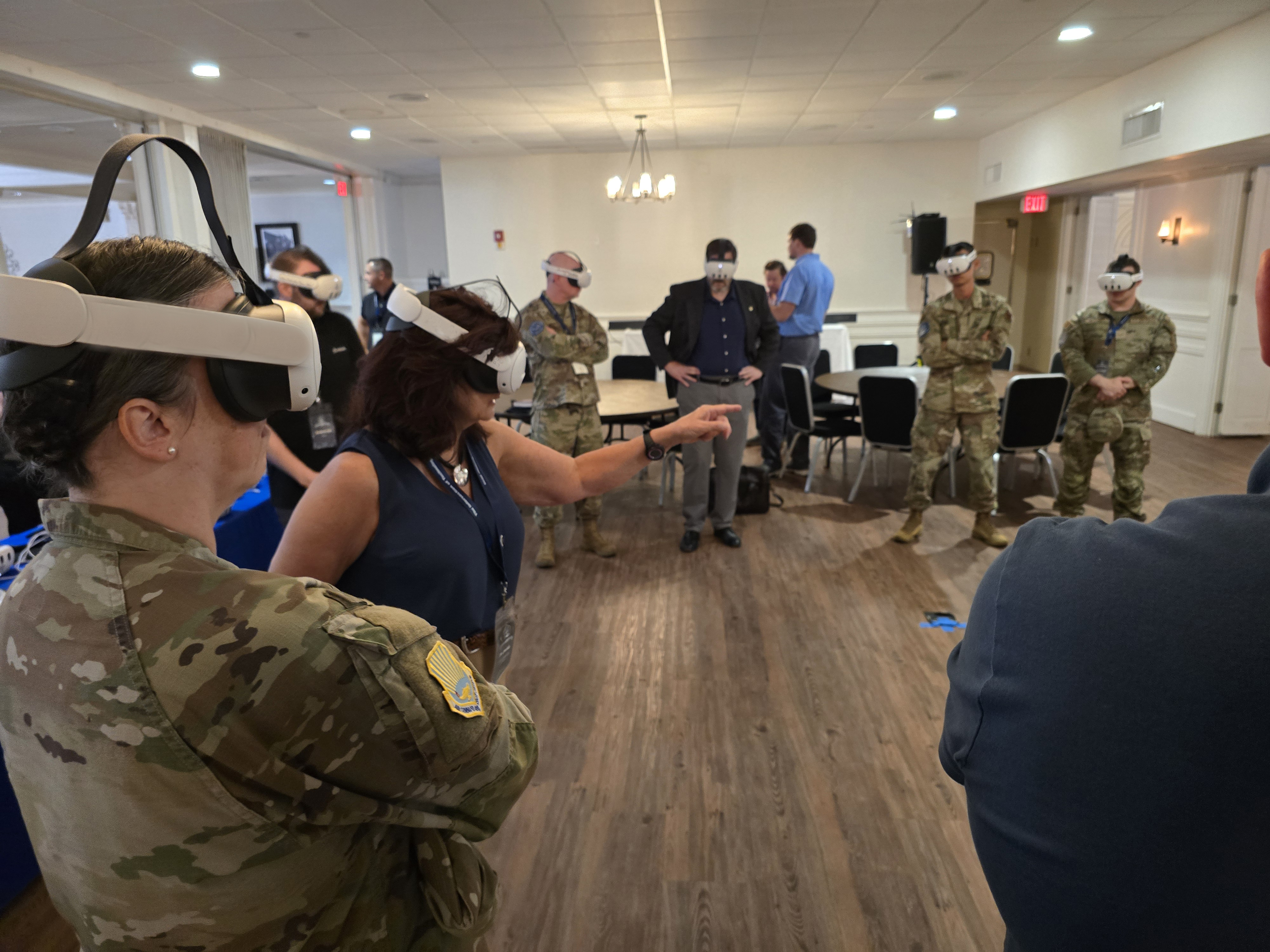
The Air Force Doctrine 2035 Wargame was a defining moment for exploring how disruptive tech will shape our future force. What impressed me most from a cyber operations perspective was the seamless integration between our Department of War professionals, academia, and industry innovators. We utilized AI for comprehensive data capture across the entire wargame to precisely measure our operational impacts. Furthermore, by bringing in different, highly specialized technologies from various industry partners for the different breakouts, particularly within the Information Operations Environment (IOE), we proved that this trilateral collaboration is exactly how we will prevent doctrinal stagnation and maintain our digital overmatch.
-- Colonel Charles "Gator" Spaulding, LeMay Center/A3/6
Across those scenarios, a clear lesson began emerging that isolated optimization is a trap. A force may assemble the most lethal strike package on paper, but if it underinvests in detection, base defense, or logistics resilience, it can still lose sortie generation, sustainment, and mission execution under pressure. In contested logistics play designed to stress ACE, the threat was immediate and concrete: mass fires, sabotage, special operations pressure, drones and swarms, and even biological threats against personnel and fuel. Moving forward in a “time-jump” mechanic allowed teams to set defenses and dispersal plans, then move forward to expose downstream effects, reinforcing a truth that cannot be briefed into existence: tempo is not created by willpower, but enabled by resilient systems, disciplined command and control, and survivable sustainment under attack.
Global strike and strategic attack scenarios drove the same point home from another angle, pushing teams beyond platform-centric thinking toward the real enablers of decisive effects inside anti-access/area-denial environments: targeting quality, delegated authority in disconnected operations, cross-domain synchronization, sustained operational pulse through advanced manufacturing, precision under degraded GPS and PNT, joint deconfliction, multi-domain sensing, and the human limits that ultimately shape endurance and decision-making at scale.
AFD35 Wargame’s evolution was about more than “what tech to buy.” It is about what must change in doctrine so Airmen can employ emerging capabilities coherently when the network frays and the timeline compresses.
“Airmen are on the front lines of revolutionary change in the way we fight wars. Whether it be AI, robotics, quantum science, or innumerable other advances, our success as an Air Force is dependent on understanding and exploiting the operational environment. Events like AFD35, allow us to bring together experts across the spectrum of government, academia, and industry to explore just how we can do that.” -- Michael Meridith, Chief, Force Management, Requirements Division, Secretary of the Air Force Office of Public Affairs (SAF/PAR)
Across the turns of play, the wargame kept steering participants back to the same hard friction points, doctrinal questions that don’t stay theoretical once the clock starts. Teams wrestled with how to generate mass and maneuver at speed in a contested environment while also determining who truly controls the airspace when autonomous platforms and multiple services operate in the same volume. They pressed through the uncomfortable edge of authority to figure out what can be delegated to machines, what must remain human judgment, and how mission command changes when AI can accelerate decisions faster than traditional command structures can absorb.
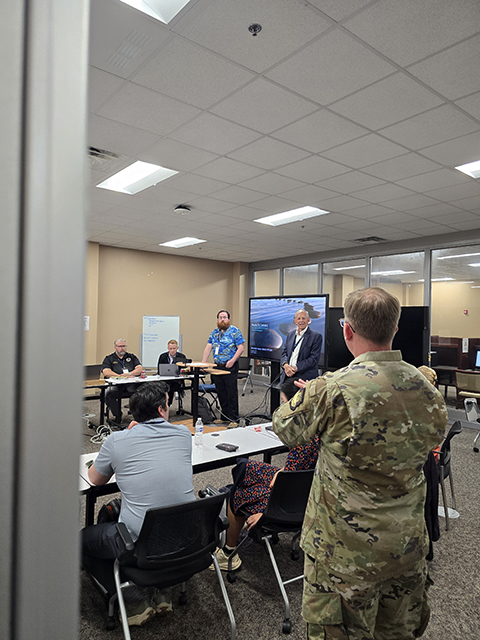
That tension echoed everywhere: Centralized Command, Distributed Control and Decentralized Execution; new command-relationship models that match the pace of modern operations; and escalation management in a world where AI-enabled decision-making can compress deterrence signaling into minutes rather than days. Our adversaries are already making Artificial Intelligence a priority in decision cycles, automated targeting, and other time-sensitive operations. This exploration in advanced technologies forces clarity on “permission to strike”, those strike approval authorities, and how to defend bases against threats that learn, swarm, and persist.
As teams pushed deeper, the planning process itself came under scrutiny, shifting from human-centric staff workflows toward agentic planning and decision support, while logistics emerged as a decisive battleground, demanding integration of AI-enabled sustainment, autonomous airlift, and forward manufacturing to keep combat power alive when the supply chain is under attack. Teams had to commit to investments, to employment, to risk acceptance. That is where doctrine earns its keep: reducing confusion under pressure by giving the force a repeatable way to think and act.
Now What?
AFD35’s wargame is not the end state; it’s a mechanism for future planning that captures the reasoning and consequences observed in play and translates those findings into doctrinal insights that Airmen can understand, train, and apply. As we look at the wargame’s translations, they have two distinct demands. First, discipline: the intent is to avoid chasing novelty and bespoke platforms and focus on operational advantage under degradation. Second, specificity: doctrine must speak clearly about authorities, decision processes, and resiliency requirements, because ambiguity becomes paralysis when adversaries are deliberately accelerating uncertainty.
“AFD35 was a revolutionary, cross-functional wargame that united industry, academia, and military operators to shape future Airpower investments and doctrine. By immersing participants in a realistic battlespace and enabling them to see the consequences of their decisions and actions, it bridged the gap between R&D and operational employment, setting a new standard for collaboration. In my eight years of running wargames, I’ve never seen such a great example of breaking down barriers to identify future requirements needed to keep our nation safe.” -- Mr. Lisle H. Babcock, Director of the Air Force Wargaming Institute, Curtis E. LeMay Center
AFD35’s broader mission is to serve as the broker for creating good operational habits, and those habits become doctrine that guides the fight. The most enduring outcome of the AFD35 Wargame may not be a single recommended capability or a single doctrinal principled concept, though those matter. It may be the shared muscle memory it creates for warfighters, industry, and academia learning how to argue honestly, decide under constraint, and trace second- and third-order effects before the nation pays for those lessons in real conflict.
In the next decade, airpower superiority won’t be secured by what the Air Force owns. It will be secured by how quickly the Air Force can turn possibility into practice, at scale, under pressure, with clear doctrine that keeps decision-making coherent when the environment is designed to confuse.
And that is the purpose of AFD35: to ensure Airmen arrive in 2035 with doctrine that has already been tested, rather than imagined, as practiced principles.