Published 31 July 2026
By LeMay Center Staff
This month, the LeMay Center highlights the origins and early development of Air Force combat search and rescue (CSAR) in the Vietnam War. In the midst of ongoing operations in and around Iran, which have included some notably heroic personnel recovery (PR) missions, it seems appropriate to highlight the Air Force’s rich history of CSAR, its primary method of accomplishing PR.
Early efforts during World War II included rescuing aircrews down at sea with specially equipped bombers, which would drop life rafts and supplies, and seaplanes, which would pick up the stranded crews. During Korea, helicopters were introduced to evacuate wounded troops to field hospitals. As operations ramped up in Indochina, the number of friendly aircraft downed in dense jungle terrain either behind enemy lines or in neutral territory necessitated creating a dedicated Air Rescue Service (later the Air Rescue and Recovery Service) and developing tactics and doctrine for its use in recovering aircrews.
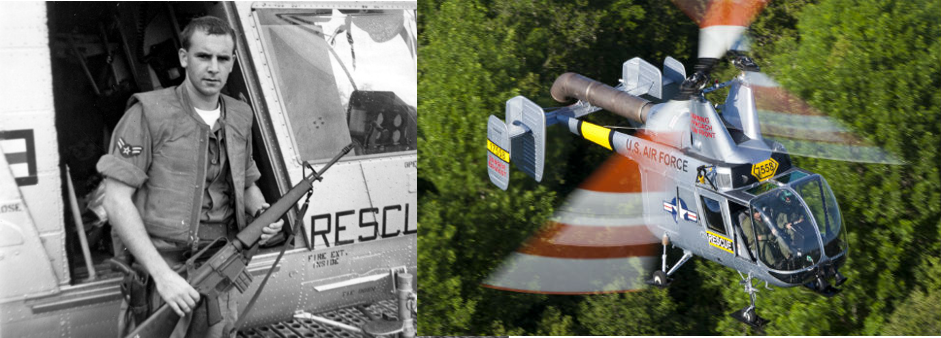
The first dedicated rescue helicopter, the HH-43 Huskie, known throughout Vietnam by its callsign, “Pedro,” entered operations in 1964. Two Pedros usually flew rescue missions accompanied by at least two Air Force or Navy A-1 Skyraiders, known by their “Sandy” callsigns, as well as airborne forward air controllers and command and control (C2) aircraft. Each mission was a carefully choreographed affair, with detailed tactics worked out in operations from 1964-67. The pararescue jumpers (PJs) who flew as part of the Pedro rescue team were among the most admired men in Theater—always the first friendly faces seen by downed fliers.
A characteristically valiant PJ mission was accomplished by A1C William Pitsenbarger (above, left) in early 1966. Part of a flight of Pedros and Sandys sent to rescue a US Army infantry company ambushed by a much larger Viet Cong force, Pitsenbarger rode his Pedro’s jungle penetrator down to the stranded soldiers, taking a bullet in the process. He chose to stay and aid the soldiers, helping the Pedros hoist out five loads of injured men before succumbing to enemy fire himself. A sixth run by the Pedros and Sandys determined that no survivors remained. For his heroism, Pitsenbarger became the first enlisted man to win the Air Force Cross, later upgraded to the Congressional Medal of Honor. CSAR missions in Vietnam were greatly facilitated by the introduction of the HH-3 “Jolly Green Giant” and the HH-53 “Super Jolly Green,” as well as much more advanced rescue escort and C2 procedures, as the war progressed.
Why it matters today: PR is a key element in sustaining the morale, cohesion, and capability of our forces. Successful recovery is a force multiplier, returning friendly Airmen and other troops to action and bolstering those facing enemy fire with the knowledge that they will not be left behind if shot down or otherwise isolated. Successful PR also denies the enemy the intelligence and propaganda value of captured personnel. Furthermore, it uplifts morale in the US and friendly nations, as was witnessed recently during the daring and complex, multi-day rescue of a downed F-15E crew behind hostile lines in Iran. From the earliest days of air rescue until today, the code of the “air rescueman” stands true: “These things I do, that others may live.” For more on the Air Force’s doctrine on PR and CSAR, see Air Force Doctrine Publication (AFDP) 3-50, Personnel Recovery. You can also explore our doctrine podcast library on iTunes, Spotify, Amazon Music, or at www.doctrine.af.mil.